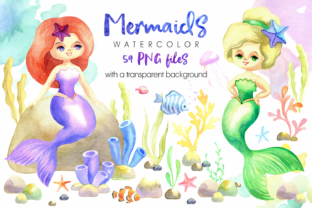
Mermaids. Watercolor Cliparts Set Review
As a designer who has spent years translating digital art into tangible thread, I approach every new asset with a mix of excitement and skepticism. When I first opened the Mermaids. Watercolor Cliparts Set, my initial reaction was one of aesthetic appreciation. The mood is undeniably whimsical, capturing that soft, dreamy quality that watercolor illustrations are famous for. However, in the world of embroidery, beauty on a screen does not always guarantee success under a needle. My goal here is to walk you through exactly how this set performs when moved from the digital realm to real-world stitching projects.
The First Impression: Translating Softness to Thread
The visual personality of these mermaid designs is gentle and fluid. Unlike bold, vector-based graphics with hard edges, these illustrations rely on gradients, bleeding colors, and soft transitions. For an embroidery file to succeed, it must be able to replicate this organic feel without looking muddy or overworked. In theory, a design like this screams for delicate fill stitch work and perhaps some subtle satin stitch accents to define the tail fins or hair strands.
When I imagine these designs on a finished product, they evoke a sense of nostalgia and magic. They are perfect for creating a boutique brand identity that feels handmade and personal. However, the challenge lies in the execution. If the stitch density is too high, the soft watercolor effect will disappear, replaced by a blocky, heavy texture. If it is too low, the colors won't blend, and the design will look unfinished. This is where practical judgment comes in before you ever load your machine.
A Real-World Scenario: The Custom Tote Bag Project
Let's picture a specific use case. You are an Etsy seller preparing a limited run of custom tote bags for an upcoming summer craft fair. You want to feature a mermaid theme that appeals to young adults and beach lovers. You select a design from the Mermaids. Watercolor Cliparts Set because it fits the "ocean vibes" perfectly. You place it on a natural canvas tote bag, centered on the front panel.
Here is where the rubber meets the road. Canvas is a textured fabric, which can sometimes swallow fine details. With a watercolor style, you need enough thread coverage to make the image pop against the weave of the fabric. If the design relies on very thin lines for the mermaid's facial features or the flow of her hair, those details might get lost in the canvas texture. In this scenario, I would strongly advise testing the design on a scrap piece of similar fabric first. Check if the stitch density holds up. Does the watercolor gradient look smooth, or does it appear as distinct, jagged blocks of color? Your customers will judge the quality of your handmade product instantly based on this clarity.
If the test run looks good, this design could elevate a simple tote bag into a premium personalized gift. The soft aesthetic pairs beautifully with neutral tones, making it versatile for various color palettes. However, if the details are too intricate for the hoop size you intend to use, the final result might disappoint. Always confirm the recommended hoop size before committing to a bulk order.
Navigating Fabric and Placement Challenges
Not every project is a sturdy tote bag. Many crafters love using these types of designs for baby clothes, pillow covers, or even aprons. Each of these presents unique challenges. On stretchy fabrics like jersey knit for sweatshirts or t-shirts, a large, detailed design can cause puckering. The Mermaids. Watercolor Cliparts Set likely contains elements that require significant stabilizer support. Without proper backing, the fabric might distort, ruining the graceful lines of the mermaid illustration.
Consider also the placement on curved surfaces, such as caps or hats. A design with wide, flowing watercolor washes might not conform well to the rounded brim of a cap. The tension required to stitch around a curve can pull the threads, breaking the illusion of softness. In such cases, you might need to resize the design significantly or choose a smaller element from the set that works better within a confined space.
Furthermore, dark fabrics present a different hurdle. Watercolor styles often rely on white or light backgrounds to show the transparency and blending of colors. Stitching this directly onto a black hoodie requires a dense underlay of white thread, which can add bulk and cost. It changes the visual appeal entirely. Before you sell a custom apparel item with this design on dark fabric, create a mockup to see if the contrast works. Sometimes, what looks beautiful on a white background becomes indistinguishable on navy blue.
Practical Designer Notes for Success
To ensure your commercial embroidery projects shine, follow these practical steps when working with the Mermaids. Watercolor Cliparts Set:
- Test on Scrap Fabric: Never skip the test stitch. Run the design on the exact fabric you plan to use to check for puckering and detail retention.
- Check Thread Color Contrast: Ensure the chosen thread colors stand out against your fabric. Watercolor effects need careful color selection to maintain their ethereal look.
- Review Stitch Density: Look at the digitization closely. Are there areas that are too dense? Too sparse? Adjust settings if your software allows, or choose a different design from the set.
- Confirm Hoop Size: Make sure the design fits comfortably within your hoop without crowding the edges, which can lead to stitching errors.
- Inspect Small Details: Zoom in on the eyes, hands, and tails. If they are too small, they may not stitch clearly. Consider simplifying or enlarging the design.
- Use Proper Stabilizer: Whether it is cut-away for stretchy fabrics or tear-away for stable ones, the right stabilizer is non-negotiable for maintaining shape.
- Verify Licensing: As a business owner, always double-check the license terms. Can you sell the finished embroidered patch? Can you resell the digital embroidery file? Understanding this protects your craft business.
Impact on Brand and Customer Trust
Ultimately, the choice of design assets affects your brand's perception. Using a cohesive set like Mermaids. Watercolor Cliparts Set across your small shop product line creates a recognizable style. Customers begin to associate your shop with that specific soft, artistic vibe. However, if the execution is poor—blurry details, uneven stitching, or fabric distortion—it damages customer trust. People buying holiday gifts or nursery decor expect high-quality finishes.
When done right, these designs offer immense value. They allow you to create unique, story-driven products that stand out in a crowded market like Etsy. The ability to offer a baby embroidery item that looks like a hand-painted masterpiece rather than a generic print can justify a higher price point. It transforms a simple commodity into a cherished keepsake.
Final Thoughts on Design Utility
The Mermaids. Watercolor Cliparts Set is a fantastic resource for designers who understand the nuances of thread and fabric. It is not a "set it and forget it" solution; it requires thoughtful application. By respecting the limitations of the medium and taking the time to test, adjust, and stabilize, you can turn these digital illustrations into stunning physical realities. Whether you are making a single personalized gift or launching a full collection of apparel decorators merchandise, the key is preparation. Treat the design with the care it deserves, and it will reward you with beautiful, professional results that your customers will love.